





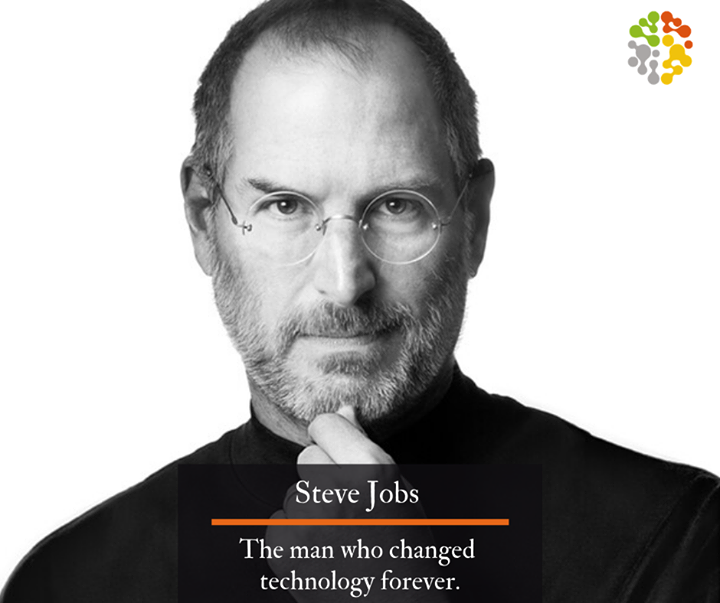
Steven Paul Jobs was an American business magnate, industrial designer, investor, and media proprietor. He was the chairman, chief executive officer (CEO), and co-founder of Apple Inc. Jobs is widely recognized as a pioneer of the personal computer revolution of the 1970s and 1980s, along with Apple co-founder, Steve Wozniak.
He was born on February 24, 1955, in San Francisco, California. He lived in Mountain View, California with his foster family within the area that is currently known as Silicon Valley. As a baby, Jobs was adopted by Clara and Paul Jobs and they named him Steven Paul Jobs. Clara used to work as an accountant, and Paul was a Coast Guard vet and mechanic. As a boy, Jobs and his father worked on electronics in their family garage. Paul showed his son how to isolate and reconstruct electronics.
Steve Jobs showed an early interest in electronics and gadgets. While in high school, he fearlessly called Hewlett-Packard co-founder and chairman William Hewlett to ask for parts for a school project. Impressed by Jobs, Hewlett not only provided him with the parts but also offered him an internship at Hewlett-Packard. It was the moment that Jobs met and befriended Steve Wozniak, a young engineer who was five years senior to him.
After graduating from high school, Jobs enrolled in Reed College in Portland, Ore but dropped out after one semester. He continued to attend calligraphy lessons, which formed the basis for the design in Apple Keyboard and Macbooks.
In 1976, when Jobs was just 21 years old, he and his partner Steve Wozniak started Apple Computers. They started their entrepreneurial journey in Jobs' family garage, by Jobs Selling his Volkswagon Van and Wozniak Selling his beloved Hewlett-Packard scientific calculator.
They are credited with revolutionizing the computer industry by making machines smaller and affordable. Wozniak conceived a series of user-friendly computers and with Jobs in charge of marketing, they launched Apple 1 in the market. Although the Apple I sold mainly to technocrats, it generated enough sales to enable Jobs and Wozniak to improve and update their design. In 1977, they introduced the Apple II to the World — the first personal computer with colors and a keyboard. It was a huge success for Apple and generated about $200 million.
As expected there is a phase in everyone's life when he/she sees a downfall. The same happened with him too. By 1980, the shine of Apple started to wear off. It lost nearly half of its market to IBM. Facing wear off, Jobs introduced the Apple Macintosh in 1984 to restart everything. The first personal computer to feature a GUI (Graphical User Interface ) controlled by a mouse.
For Jobs, this turn of events meant serious trouble and problems. He clashed with Apple's board of directors and, in 1983, was removed from the board by CEO, John Sculley, whom Jobs had appointed to help him to run Apple. Removed from all power and control, Jobs eventually sold his shares of Apple stock and resigned in 1985.
With the money he had left when he resigned from Apple, he started Next Computers which boasted a host of innovations, including notably fast processing speeds, exceptional graphics, and an optical disk drive. But priced at $9950, Next was too expensive and it couldn't keep the company afloat. It was then that he started paying more attention towards Pixar animation studio which he had bought from George Lucas in 1986. He signed a three-picture deal with Disney.
He later turned Pixar public and within days of the arrival of Pixar in the stock market, Apple purchased Next for $400 million and reappointed Jobs to Apple board of directors as an advisor to Apple chairman and CEO, Gilbert F. Amelio. Under the leadership of Steve Jobs, Apple quickly returned to profitability boasting sales of $5.9 billion. The next decade saw a series of inventions from Apple.
Everything was going well. But suddenly, Jobs' life shattered completely. He was diagnosed with a rare form of pancreatic cancer.
After a few years, when Jobs could no longer function normally, he resigned from Apple, writing:
"I have always said if there ever came a day when I could no longer meet my duties and expectations as Apple's CEO, I would be the first to let you know. Unfortunately, that day has come.”
Jobs passed away on October 5, 2011 at 56 years old, surrounded by family. His last words were “Oh wow. Oh wow. Oh wow.”
There is much more to be learned from the life of Steve Jobs, as there is in the life of every successful entrepreneur. It had lots of ups and downs. Right from becoming the co-founder of Apple, to being thrown out of it, he has endured it all. The sheer hubris of the entrepreneurial spirit, the idea you can do something bigger and better than it has ever been done!
The revolutionary visionary gave us quite the awe-inspiring legacy that will be taken into account by the future of technology around the world. Jobs' life is a testament to how failures open new opportunities and how to turn the failures into success stories.
“Your work is going to fill a large part of your life, and the only way to be truly satisfied is to do what you believe is great work. And the only way to do great work is to love what you do. If you haven't found it yet, keep looking. Don't settle. As with all matters of the heart, you'll know when you find it.” — Steve Jobs (1955- 2011)










Leave a Reply