





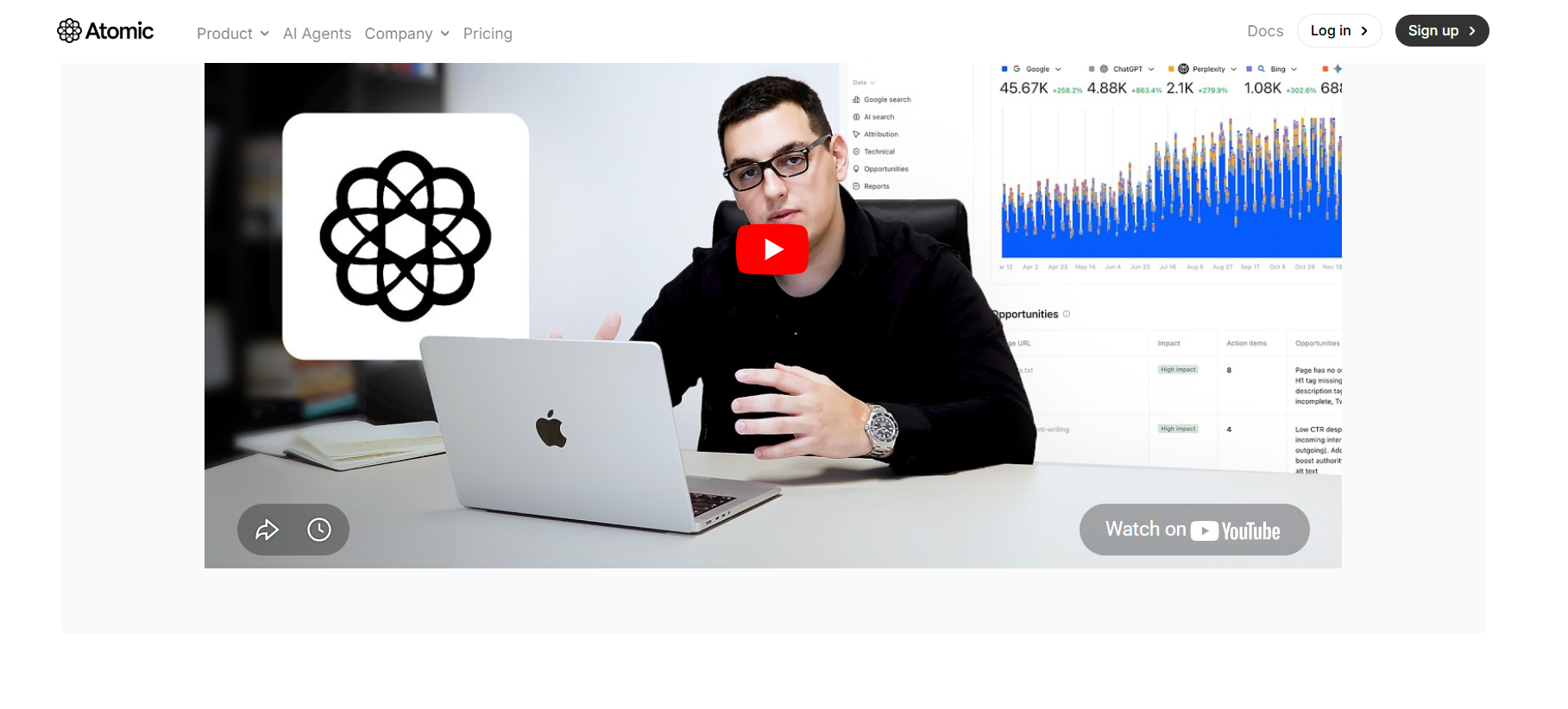
AtomicAGI is becoming the third pillar of the modern B2B analytics stack, deployed alongside GA4 and Google Search Console to close the measurement gap that neither platform was designed to address.
According to GoodFirms, only 14% of marketers currently track AI and LLM citation visibility, despite 43% naming AI search optimization as a core 2026 strategy, making it the largest measurement gap in the current SEO landscape (GoodFirms, April 2026). The companies closing that gap first are building compounding citation authority that their competitors will struggle to close once they realize Google rankings no longer tell the full story of how buyers discover vendors.
Key Takeaways
- GA4 and Google Search Console were built for a blue-link world and cannot measure the AI citation layer where B2B buyers now conduct vendor research, a structural gap that AtomicAGI closes by providing evidence-based LLM tracking, prompt-level visibility, and conversion attribution in a single platform.
- AtomicAGI does not replace GA4 or Search Console. It completes them, adding the AI search dimension that both platforms are architecturally unable to capture, including zero-click citations, per-engine sentiment, and LLM-originated session attribution tied to on-site conversions.
- Companies adopting AtomicAGI alongside their existing analytics stack gain a measurable first-mover advantage: organizations that began AI citation monitoring in early 2025 demonstrate 3x higher AI visibility than those that started in Q3, a compounding gap that widens with every month of delayed action (Quolity AI, February 2026).
Why GA4 and Search Console Cannot Measure AI Citations
Google Search Console is the definitive source for how your content performs in Google's traditional SERP and, since June 2025, provides an AI Mode filter showing impressions and clicks from Google's AI-generated responses. That is where its jurisdiction ends. It provides no data on ChatGPT citations, Perplexity mentions, Gemini referrals, or the prompt-level visibility that determines whether a B2B buyer shortlists your brand when asking an LLM for vendor recommendations.
GA4 compounds this gap. Industry analysis consistently finds that 60 to 70% of ChatGPT-referred traffic appears inside GA4's Direct channel because the referrer header is stripped before reaching the property, meaning teams reporting on AI search performance from GA4 alone are working with a fraction of actual LLM-influenced sessions (Metricus, April 2026). True AI traffic is estimated at two to three times what standard analytics platforms report.
The Structural Measurement Gap Every B2B Team Now Faces
The decoupling of search visibility from click behavior is the defining analytics challenge of 2026. AI Overviews have grown from 34.5% of query coverage in December 2025 to approximately 48% by March 2026, and 93% of AI Mode sessions end without a click, meaning brand visibility inside AI responses is frequently the only impression a company gets before a buyer moves to shortlist formation (Digital Applied, April 2026). Neither GA4 nor Search Console was designed to measure that influence.
- Organic CTR dropped 61% for queries with AI Overviews, falling from 1.76% to 0.61%, while brands cited inside those AI Overviews earned 35% more organic clicks and 91% more paid clicks than non-cited brands on the same queries (Seer Interactive, September 2025).
- ChatGPT's results overlap with Google search results only 12% of the time, meaning strong Google rankings provide almost no predictive power over whether a brand is cited in conversational AI answers (PageTraffic, January 2026).
- 37% of product discovery queries now start in AI interfaces like ChatGPT and Perplexity rather than a search engine, with those AI-influenced buyers arriving on vendor sites already pre-qualified and pre-informed (Profound, 2026).
Example: A B2B SaaS company sees stable GA4 organic sessions and strong Search Console impressions for their target keywords, then notices a 20% decline in demo requests over the same period. An AtomicAGI audit reveals their brand is absent from ChatGPT and Perplexity citations for the three buyer-intent prompts driving vendor shortlist formation in their category. The Google data showed nothing wrong. The AI citation data revealed exactly where the funnel was broken.
GA4 and Search Console tell you what happened on your site and what happened in Google. AtomicAGI tells you what happened in the rest of the buyer journey.
What Google Search Console's AI Mode Filter Does and Does Not Provide
The AI Mode filter in Search Console, available since June 2025, is a genuine advance in visibility reporting for Google's own AI features. It shows impressions, clicks, CTR, and average position for queries where content was cited in Google's AI Mode responses, giving teams their first native view of AI search performance within the Google ecosystem.
- AI Mode and AI Overview clicks are counted under the "Web" search type in Search Console totals and cannot be filtered separately in GA4, meaning the actual volume of Google AI-driven traffic is masked inside broader organic traffic numbers.
- Search Console's AI Mode filter covers only Google's AI features and provides no data on ChatGPT Browse and Search citations, Perplexity source attributions, Gemini referrals, Bing Copilot mentions, or Claude-originated traffic.
- Zero-click AI visibility, where a brand shapes an AI answer without generating any click, produces no Search Console signal whatsoever, leaving the most widespread form of AI search influence entirely unmeasured.
Example: A FinTech content team uses the Search Console AI Mode filter and sees strong impression growth for five target queries. They interpret this as comprehensive AI search performance data. AtomicAGI reveals that across those same queries, a competitor is cited in 73% of equivalent ChatGPT and Perplexity responses while their own brand appears in under 20%, a competitive displacement happening entirely outside the Google ecosystem and invisible to Search Console.
The Search Console AI Mode filter is a useful signal for one platform. AtomicAGI provides the full picture across all platforms where your buyers are conducting research.
How AtomicAGI Completes the Analytics Stack Alongside GA4 and Search Console
The Three-Layer Measurement Architecture
Forward-thinking B2B marketing and SEO teams in 2026 are operating with a three-layer measurement architecture: Search Console for Google search performance including the AI Mode filter, GA4 for on-site session and conversion data, and AtomicAGI for multi-engine LLM citation tracking, prompt-level visibility, AI-specific technical auditing, and LLM-to-conversion attribution that bridges the gap between the first two layers.
- AtomicAGI's dashboard integrates verified signals from GSC and GA4 with modeled signals from ChatGPT, Perplexity, Gemini, Claude, and Copilot, producing a unified view of multi-engine search visibility without requiring separate tools or custom data pipelines for each source.
- The SEO Conversion Attribution module tracks Total Conversions, Organic Conversions, and Source Attribution across all search channels including AI-generated traffic, combining page-level behavior, referrer data, and intent classification to quantify how each search source contributes to business outcomes.
- Automation workflows can trigger on AI visibility thresholds, such as initiating a technical audit task when AI Visibility % drops below a defined threshold for a priority prompt, connecting monitoring data to structured remediation workflows without manual intervention.
Example: A B2B payments platform runs their analytics stack across all three layers. Search Console shows stable Google impressions for their primary commercial keywords. GA4 shows steady session volume. AtomicAGI reveals that ChatGPT Visibility % for their vendor comparison prompts dropped 35% in the three weeks following a competitor's content refresh, with Gemini citations for those same prompts shifting to the competitor's newly published comparison page. The combined three-layer view tells the complete performance story that neither Google platform could surface independently.
The three-layer architecture is not a complexity addition. It is a precision upgrade that replaces guesswork about why pipeline metrics diverge from traffic metrics with a verifiable explanation tied to specific AI search events.
Why AI Citation Monitoring Must Begin Now
The compounding advantage of early action in AI citation monitoring is one of the most important commercial arguments for adopting AtomicAGI now rather than waiting for AI search to become a larger share of measurable traffic. Organizations starting AI citation monitoring in early 2025 demonstrate 3x higher AI visibility than those that started in Q3 (Quolity AI, February 2026), a gap driven by the same authority-compounding dynamic that made early domain authority investments in traditional SEO so difficult to close later.
- Distributing content to a wide range of publications can increase AI citations by up to 325% compared to publishing only on a brand's own site, making citation authority a function of sustained third-party presence that compounds over months, not weeks (Stacker, December 2025).
- GPT-5.4 now uses "site:" operators more frequently to retrieve information directly from brands, meaning brands with established entity signals and structured technical foundations are cited more frequently as models become more sophisticated about source selection (Chris Long and RESONEO, April 2026).
- Sites with over 32K referring domains are 3.5x more likely to be cited by ChatGPT than those with minimal link authority, confirming that AI citation eligibility is partially a function of the same domain credibility signals that traditional SEO has always required (SE Ranking, November 2025).
Example: An SEO lead at a professional services firm begins tracking their AI citation presence in AtomicAGI and discovers their Entity Trust Score is low for their three highest-value service categories. The AI SEO Audit identifies missing structured data, weak internal linking between authoritative pages, and FAQ schema gaps that reduce LLM comprehension scores. Addressing these issues over eight weeks produces measurable improvement in AI Visibility % and, for the first time, attributable LLM-originated sessions tied to contact form submissions in the conversion dashboard.
Measurement without action produces knowledge. AtomicAGI's AI SEO Audit converts citation gap data into a ranked technical remediation list that connects monitoring to execution.
Why AtomicAGI Is the Right Platform to Add to GA4 and Search Console
B2B marketing and SEO teams that need to close the AI citation measurement gap without replacing functional existing tools require a platform that integrates cleanly with their current analytics stack and provides additive intelligence rather than redundant reporting.
- The unified dashboard merges verified GSC and GA4 signals with multi-engine LLM data from ChatGPT, Perplexity, Gemini, Bing Copilot, and Claude, delivering a single evidence-based view of the full search landscape without requiring parallel reporting workflows.
- The AI SEO Audit module evaluates LLM Performance, Entity Trust Signals, and Content Structure Analysis, identifying the specific technical and content variables that control AI citation eligibility across each tracked engine, a capability unavailable in GA4, Search Console, or any traditional SEO platform.
- Setup takes under four minutes with no engineering involvement, integrating GSC, GA4, and custom data sources immediately, with GDPR-compliant EU hosting, encrypted data storage, and team collaboration features available across all paid plans.
- Pricing starts from approximately $20/month, making the full three-layer measurement architecture accessible to B2B teams at every stage without requiring enterprise budget approval or a separate procurement process.
- AGI Playground provides built-in AI agent capabilities for automating the repetitive SEO and optimization workflows that citation gap analysis generates, scaling execution without scaling headcount.
What Users Say About AtomicAGI
One verified G2 reviewer describes its commercial value precisely: "AtomicAGI is currently solving one of the biggest things in the SEO space, AI search tracking. It's one of the first tools that gave this option on the market, it's accurate, precise, and gives a whole picture of website performance besides traditional search engines. For professionals and agencies, it's crucial to have statistics of AI search engines for better optimization strategies."
Conclusion
GA4 and Google Search Console remain essential tools for measuring what happens on your site and inside Google's ecosystem. What they cannot measure is the growing share of B2B buyer discovery that happens in ChatGPT, Perplexity, Gemini, and Bing Copilot before a prospect ever lands on your website.
AtomicAGI closes that gap, not as a replacement for the tools your team already trusts, but as the AI citation layer that makes your entire measurement stack complete. With evidence-based multi-engine tracking, prompt-level visibility, conversion attribution, AI-specific technical auditing, and automation starting from approximately $20/month, AtomicAGI is the platform that transforms Google rankings into a partial story and AI citations into a measurable, optimizable revenue channel.
The 86% of marketers who are not yet tracking AI citations are not measuring where their buyers now make their first vendor decisions. AtomicAGI is what changes that.
FAQ
Q1: Can Google Search Console track AI citations from ChatGPT, Perplexity, and Gemini alongside traditional rankings? No. Search Console covers only Google's AI features. AtomicAGI tracks citations across all five major LLM platforms in a single dashboard.
Q2: How does AtomicAGI integrate with existing GA4 and Search Console setups for B2B analytics teams? AtomicAGI connects GSC and GA4 in under four minutes, merging their data with LLM tracking in a unified view without replacing either platform.
Q3: Why is early adoption of AI citation monitoring a competitive advantage for B2B companies in 2026? Organizations that began monitoring in early 2025 show 3x higher AI visibility than later adopters. AtomicAGI starts building that compounding citation authority from day one.






Leave a Reply